










Choosing the wrong business phone system creates long-term operational and financial problems. Some businesses invest heavily in on-premise PBX infrastructure they later struggle to scale. Others move to hosted VoIP and discover that compliance requirements or connectivity issues were not properly considered first.
There is no universal answer. The right choice depends on how your business operates, how much infrastructure control you need, your IT capacity, and how your communication requirements are likely to change over the next few years.
UK businesses also face a pressing deadline. The PSTN and ISDN switch-off is scheduled for January 2027. If your current phone system relies on traditional copper lines, acting now rather than waiting gives you far more control over the outcome.
This guide compares hosted VoIP and on-premise PBX across cost, scalability, remote working, security, and long-term flexibility so you can make a decision based on your specific situation.
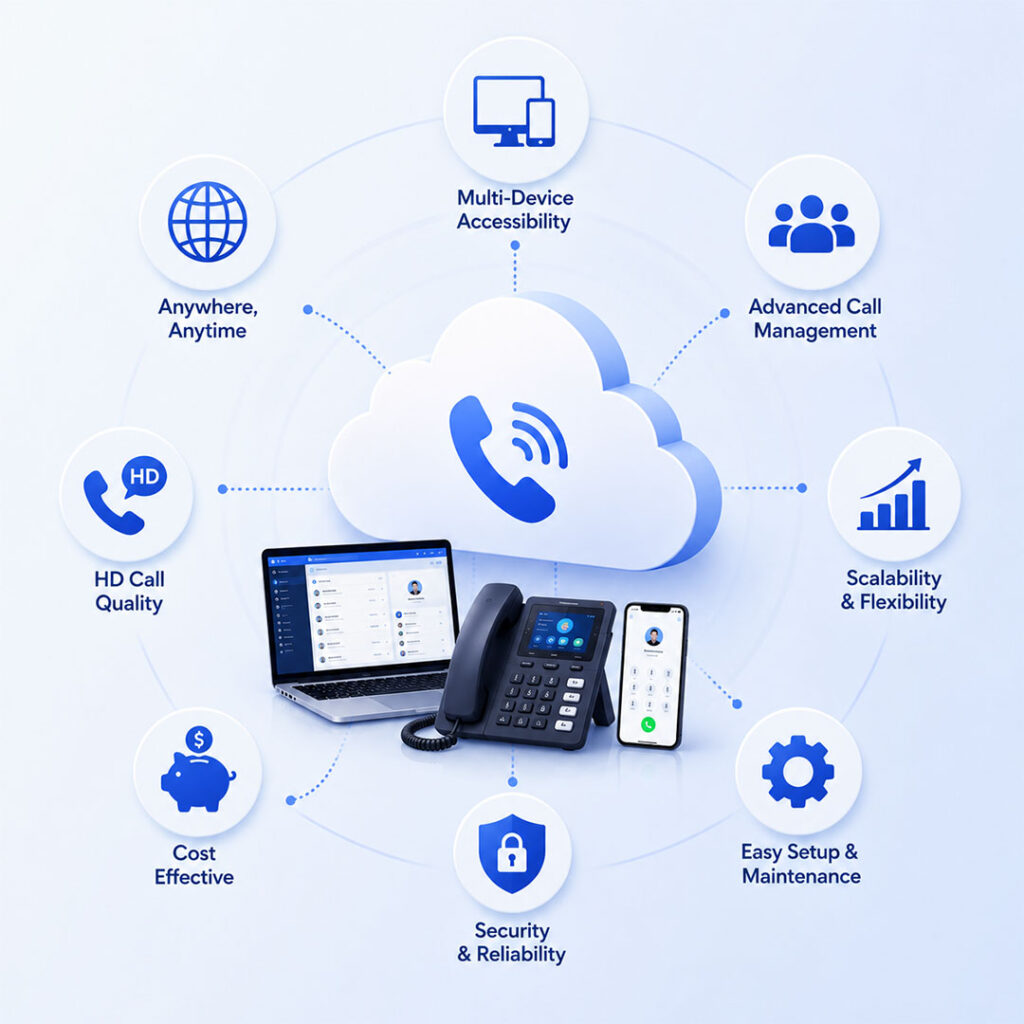
A hosted VoIP phone system delivers business calls over the internet using cloud infrastructure managed by a third-party provider. Your business does not need to purchase or maintain PBX servers only compatible devices and a reliable internet connection.
Employees make and receive calls through desk phones, softphone apps, or mobile devices. The provider handles infrastructure, security patches, updates, and system maintenance behind the scenes.
Best suited to: SMBs, remote and hybrid teams, multi-site businesses, and organisations with limited internal IT resource.
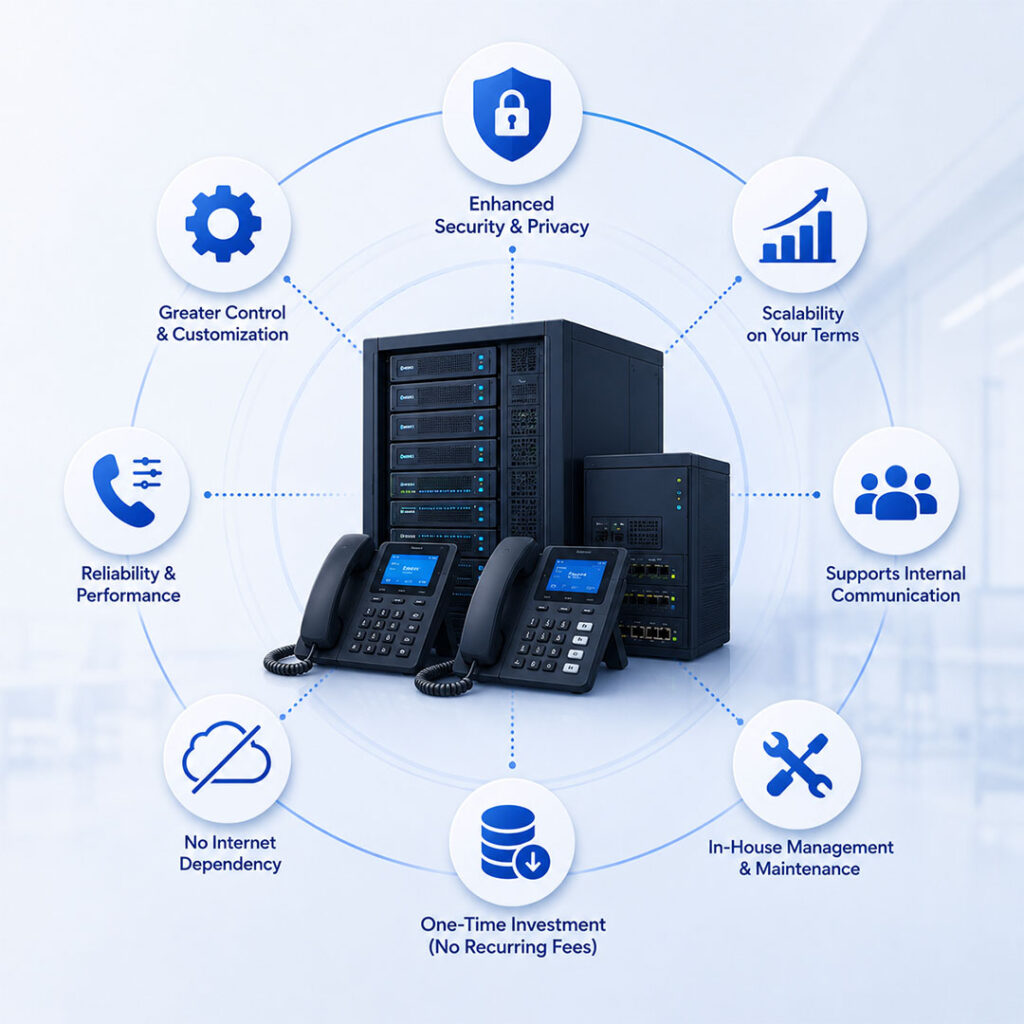
An on-premise PBX (Private Branch Exchange) is a business phone system installed and managed within your own organisation. Your business owns the hardware and software. Calls connect through SIP trunking or traditional phone lines, and your internal IT team manages maintenance, upgrades, and configuration directly.
On-premise PBX gives businesses greater control over infrastructure, data handling, and customisation but it also requires significantly more IT involvement, upfront investment, and ongoing maintenance than a hosted solution.
Best suited to: Large enterprises, regulated industries (financial services, healthcare, legal), and businesses with complex legacy system integrations.
AT GLANCE
← Scroll →
| Factor | Hosted VoIP | On-Premise PBX |
|---|---|---|
| Upfront Cost | Low | High |
| Monthly Running Cost | Predictable per-user fee | Variable — maintenance dependent |
| Deployment Speed | Days | Weeks |
| Remote Work Support | Strong | Limited without extra setup |
| Scalability | Simple | Complex and costly |
| IT Requirement | Minimal | Significant |
| Customisation | Moderate | High |
| Data Control | Provider-managed | Internally controlled |
| Internet Dependency | Heavy | Partial |
| Best For | SMBs, remote teams, growing businesses | Enterprises, regulated sectors, complex environments |
Hosted VoIP
CHOOSE IF
you want fast deployment, predictable costs, and a system built for flexible, distributed working.
on-premise PBX
CHOOSE IF
you need full infrastructure ownership, deeper customisation, or operate in a sector with strict data sovereignty or compliance requirements
Hosted VoIP deployments typically take days. The provider handles backend configuration your team needs compatible devices and a stable connection.
On-premise is a different picture:
| Scenario | Hosted VoIP | On-Premise PBX |
|---|---|---|
| Adding one user | Adjust subscription, provision account | Hardware audit, possible capacity upgrade, engineer involvement |
| Adding 10+ users | Same process, slightly more admin | Significant infrastructure and licensing review |
| Reducing headcount | Adjust subscription down | Hardware sits idle, costs remain |
For businesses with growing or fluctuating headcount, the friction of on-premise scaling compounds quickly.
Hosted VoIP platforms are designed for distributed working. Employees access the full system from any location softphone apps, mobile devices without complex VPN setup.
On-premise systems were not built with remote work as a core feature. Extending them to remote users requires:
For most businesses with remote or hybrid teams, hosted VoIP is the more practical option.
On-premise gives your organisation direct control over call data, records, and security configurations no third party involved. You set data storage rules, access permissions, and security protocols entirely within your own infrastructure.
Hosted VoIP providers operate to strong security standards (look for ISO 27001 certification and UK GDPR compliance), but your data does sit within their infrastructure.
On-premise PBX offers deeper customisation complex call routing logic, bespoke configurations, and legacy system integrations that hosted platforms frequently cannot accommodate.
Hosted PBX platforms have solid and growing feature sets with API-based integrations. However, development priorities follow the provider’s roadmap, not your requirements. If your telephony needs are non-standard or tightly tied to legacy infrastructure, on-premise gives you greater flexibility.
| Responsibility | Hosted VoIP | On-Premise PBX |
|---|---|---|
| Software updates | Provider | Internal IT / managed contract |
| Hardware failures | Provider | Internal IT / managed contract |
| Security patches | Provider | Internal IT / managed contract |
| Infrastructure monitoring | Provider | Internal IT / managed contract |
Businesses with lean IT teams often discover the true weight of on-premise maintenance only when something goes wrong at a critical moment.
Hosted VoIP depends heavily on internet connectivity. Most providers offer failover options mobile app continuity, call forwarding, redundant connection routing but your connectivity quality directly affects call quality.
Some on-premise systems can maintain internal calling during internet outages, though this depends on specific system architecture rather than being a universal guarantee.
If internet reliability is a genuine concern at your location: discuss both failover scenarios in detail with any prospective provider before committing.
Compare hosted vs on-premise options side by side
The most important distinction here is not just which costs more in year one — it is how the costs are structured over time.
Reality check: The true cost of on-premise when IT resource, maintenance, and hardware refresh are fully accounted for frequently exceeds a hosted subscription over three to five years for SMBs. At enterprise scale with an established IT team, the calculation shifts. But for most growing businesses, hosted VoIP converts a large capital outlay into a manageable and predictable monthly expense.
Understand real business phone system costs before you commit
Hosted VoIP consistently delivers for these business profiles:
On-premise PBX remains a sound investment in specific, well-defined scenarios:
A hybrid phone system combines on-premise PBX infrastructure with cloud-based hosted VoIP components and for many UK businesses, it is currently the most pragmatic path forward.
The typical setup retains existing on-premise hardware while layering cloud features on top:
Core internal telephony stays on-premise. The hosted layer adds flexibility without forcing a full infrastructure replacement before you are ready.
Important for UK businesses: The PSTN and ISDN switch-off is scheduled for January 2027. If your on-premise system still relies on ISDN or traditional copper lines, migrating to SIP trunking is not optional it is a deadline. A hybrid approach using SIP trunks alongside existing PBX hardware is a viable path that avoids a disruptive full system replacement.
Hybrid tends to be transitional rather than permanent. Most businesses using it are moving progressively towards a fully hosted solution as legacy hardware reaches end-of-life.
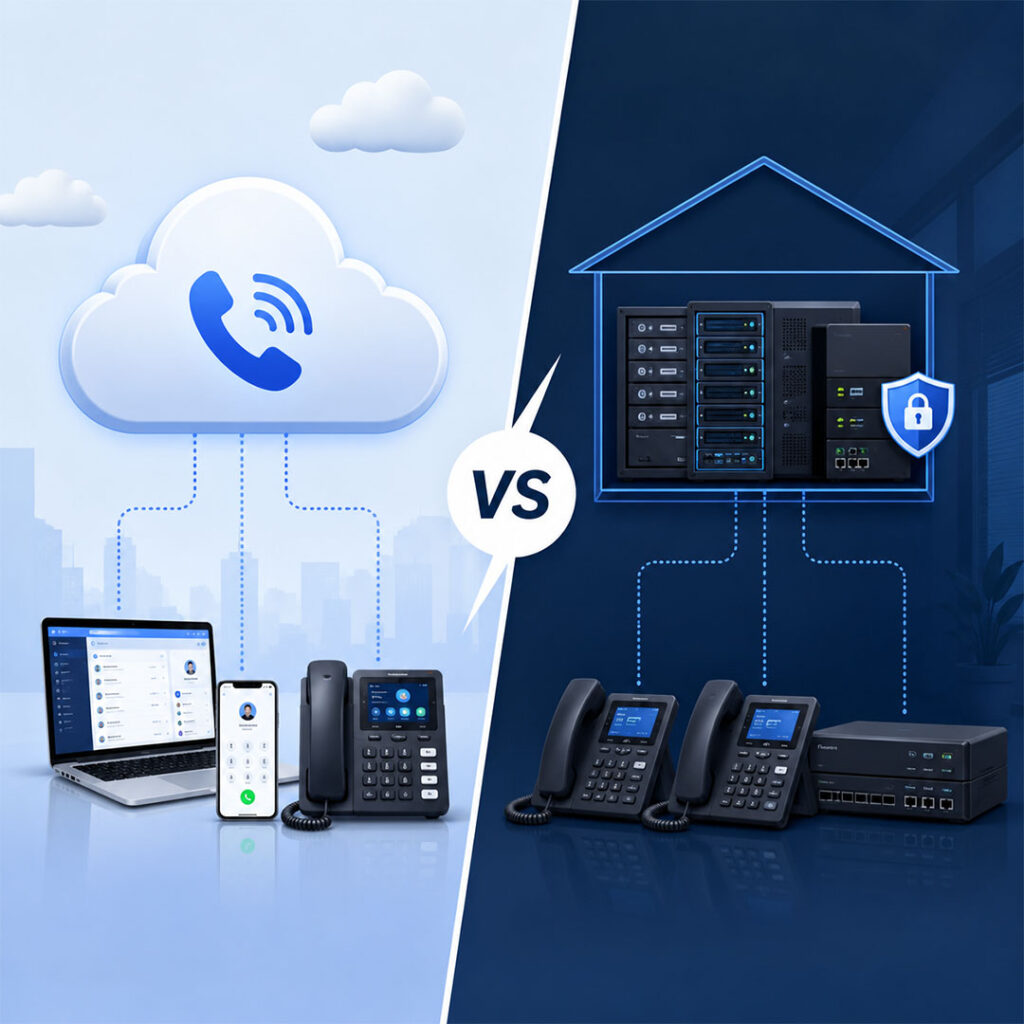
Use this as an honest mirror for your own situation:
Hosted VoIP is likely the stronger fit if:
On-premise PBX is likely the stronger fit if:
Neither fits cleanly? A hybrid architecture is worth exploring — particularly if you have existing on-premise investment you are not ready to retire but want cloud features now.
Match your phone system to your business priorities
The right decision between hosted VoIP, on-premise PBX, and hybrid phone systems depends on details specific to your business: current infrastructure, team size, budget structure, compliance requirements, and how your communication needs are likely to evolve.
Compare Phone Systems helps businesses assess actual requirements and compare providers side by side — so the decision is based on your situation, not a vendor’s recommendation.
Whether you are moving away from a legacy ISDN setup ahead of the 2027 switch-off, evaluating business VoIP systems for the first time, or exploring whether a hybrid approach makes sense, we can help you find the right fit.
Compare trusted UK providers matched to your requirements
Usually yes, particularly upfront. Hosted VoIP eliminates PBX hardware, installation, and ongoing infrastructure maintenance costs. However, total long-term cost depends on your business size, IT resources, and how long you plan to use the system. Large enterprises with existing infrastructure and capable IT teams may still find on-premise more cost-effective over a five to ten year horizon.
Yes. A hybrid phone system combines on-premise PBX infrastructure with hosted VoIP features allowing businesses to keep existing hardware while adding cloud functionality such as remote working, softphone apps, or cloud voicemail. Hybrid setups are commonly used during migration from legacy PBX systems to fully hosted solutions.
Not entirely. On-premise PBX remains relevant for businesses requiring greater infrastructure control, strict compliance, or complex legacy integrations. However, hosted VoIP is now the more practical option for most SMBs easier to deploy, maintain, scale, and adapt to remote working.
Hosted VoIP is considerably easier to maintain. The provider manages updates, security patches, infrastructure, and system monitoring. On-premise PBX requires internal IT management or a managed service contract to handle maintenance, upgrades, and troubleshooting — with your business bearing the cost and risk.
Hosted VoIP. Employees make and receive business calls from anywhere using desk phones, softphone apps, or mobile devices. On-premise systems can support remote users but typically require significant additional infrastructure, VPN configuration, and ongoing IT management.
SIP trunking delivers business phone lines over the internet instead of traditional PSTN or ISDN copper lines. It matters because businesses keeping on-premise PBX hardware after the UK PSTN switch-off must use SIP trunking for external calls. Many existing PBX systems are SIP-compatible — check your hardware specifications before assuming a full system replacement is necessary.
Your PBX hardware can continue working after the switch-off, but traditional copper and ISDN lines will stop functioning. Businesses must migrate to SIP trunking or another IP-based calling solution for external calls. In many cases, existing PBX hardware can be retained if it supports SIP connectivity — avoiding a full system replacement.
Before committing, review: minimum contract length and notice period for cancellation, what happens to your numbers if you leave, uptime SLA and compensation terms, data residency and GDPR compliance documentation, and whether international calling costs are included or metered separately.
Final Verdict
For most UK SMBs, hosted VoIP is the more practical and financially manageable choice. It deploys faster, scales with less friction, and suits the way businesses now operate distributed teams, multiple locations, a preference for monthly costs over capital outlay.
On-premise PBX remains the right choice for specific organisations: those with genuine compliance obligations around data residency, complex legacy integration requirements, or the internal resource and financial scale to justify owning infrastructure long term.
For UK businesses still on ISDN or traditional copper lines, the January 2027 PSTN switch-off adds real urgency. Whether you move to hosted VoIP, retain on-premise with SIP trunking, or adopt a hybrid model acting well before the deadline gives you far more control over the process and outcome.