- Free tier up to 10 users
- Large UK reseller ecosystem
- Browser-based video (no plugin)
- Simple wizard setup
- Strong CRM integrations
- Deep Windows & on-prem support









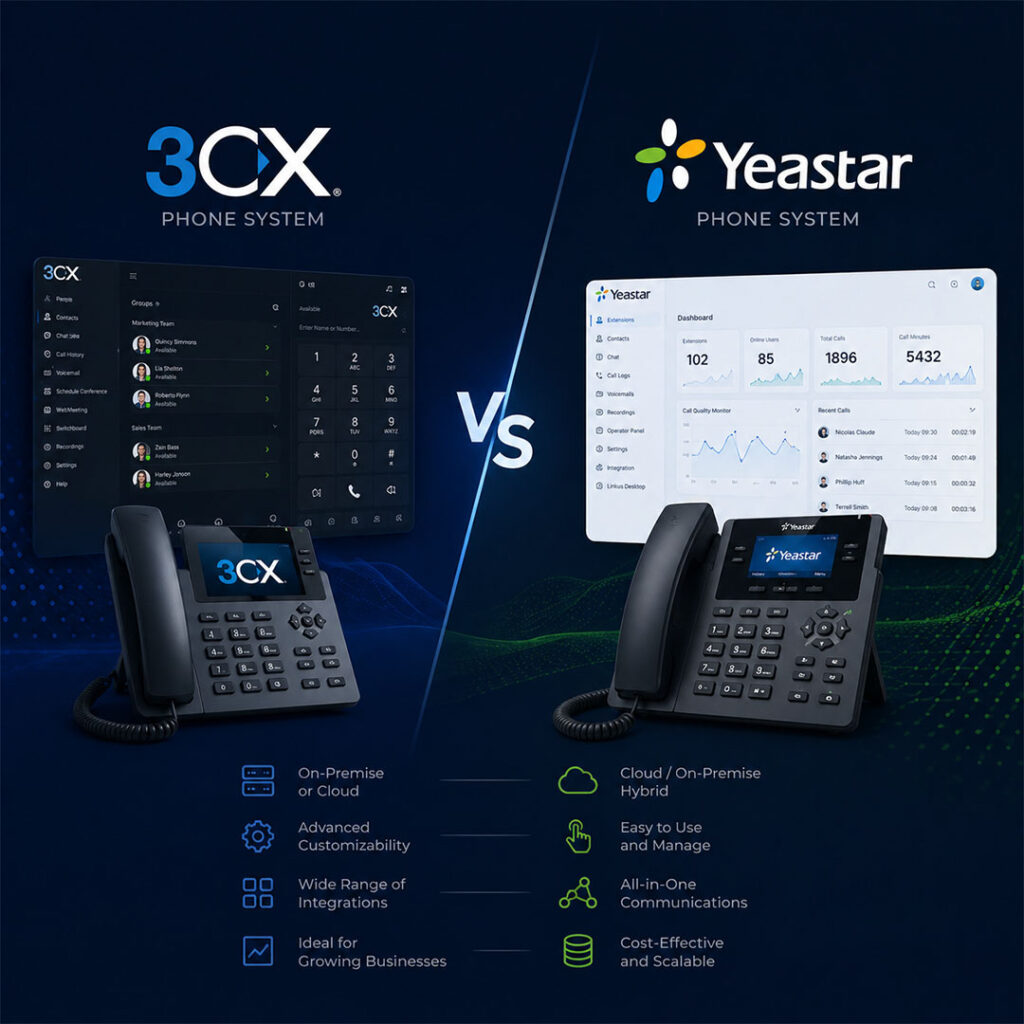
3CX and Yeastar are two widely used business PBX platforms, but they approach deployment, licensing, and day-to-day management differently. While both systems cover core VoIP functionality, the right choice often depends on factors such as team size, Microsoft Teams usage, device environment, and long-term operating costs.
This comparison reviews pricing, deployment flexibility, integrations, support structure, and practical business use cases using publicly available information, reseller feedback, and vendor documentation.
How we evaluated: We compared 3CX and Yeastar across pricing structure, deployment flexibility, Teams integration, device compatibility, CRM connectivity, long-term operating cost, and day-to-day management considerations commonly evaluated by UK businesses.
QUICK VERDICT
Both platforms are capable business phone systems, but they suit different types of organisations. In general, 3CX tends to appeal more to Windows-heavy environments and businesses needing advanced call handling, while Yeastar focuses more on bundled features, simpler management, and appliance-based deployments.
3CX
BETTER FOR
Yeastar
BETTER FOR
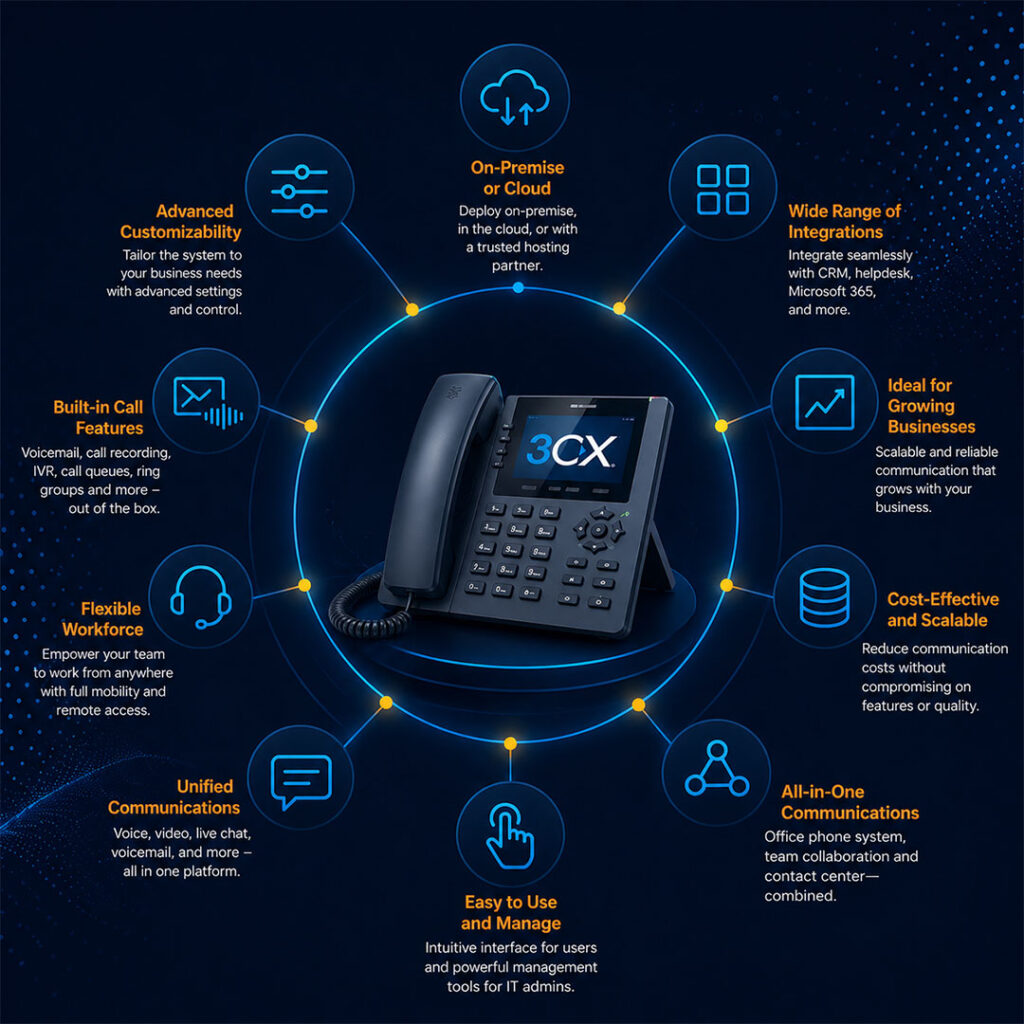
3CX is a software-based PBX platform used by businesses of all sizes to manage voice calls, video conferencing, and messaging. It runs on Windows or Linux and can be deployed on your own server, in the cloud, or hosted directly by 3CX. It is known for its free tier for small teams, its large UK reseller network, and its browser-based video conferencing tool. 3CX is widely used across Europe and holds significant market share in the UK IP PBX sector.
Yeastar is a business communications platform available as cloud software, a virtualised deployment, or a physical hardware appliance (the P-Series). It is designed to simplify day-to-day PBX management and is known for bundling features such as the Operator Panel and Microsoft Teams integration that other platforms typically charge extra for. Yeastar is growing its UK presence and is commonly chosen by businesses looking for an all-in-one solution with lower long-term overhead.

AT GLANCE
← Scroll →
| Factor | 3CX | Yeastar |
|---|---|---|
| Licensing cost | Starts ~£115/yr (4 calls, Pro edition) | Can be lower-cost depending on deployment size, licensing structure, and included features |
| Free tier | Yes — up to 10 users, cloud-hosted | Free trial only |
| Mac desktop app | Not available (web client only) | Full macOS support via Linkus |
| Teams integration | Via SBC (typically requires additional licence) | Two free integration routes — no Teams Phone licence required |
| Operator Panel | Paid add-on | Included free with drag-and-drop interface |
| Auto-provision phones | ~250 supported models | 450+ supported models |
| Video conferencing | Browser-based, no plugin required | Via Linkus app (download required) |
| Physical appliance | Software only (no hardware option) | P-Series hardware appliances available |
| UK reseller network | One of the largest in the UK | Growing network (smaller but expanding) |
| Multi-tenancy | Shared-instance architecture | True per-tenant isolation |
| CRM connectors | Wider pre-built integration library | Covers all major UK CRMs |
| Setup experience | Wizard-driven and widely praised | Clean UI, slightly more initial configuration required |
| Manufacturer support | Via resellers only | Direct manufacturer support included |
See Real PBX Cost Differences
Both systems include standard PBX functionality such as IVR, call queues, voicemail-to-email, ring groups, and call recording. The differences become more noticeable in areas such as queue management, admin workflow, remote usage, and platform flexibility.
3CX’s Enterprise Queue Panel stands out for dynamic agent support, wallboards, and drag-and-drop assignment commonly preferred for high-volume inbound contact centres.
Yeastar’s call queue handling is adequate for most SME environments, and its free Operator Panel replaces a paid 3CX add-on for reception-heavy businesses.
3CX uses a setup wizard that resellers find quick to configure.
Yeastar consolidates related settings on single pages for example, all IVR controls in one place which some admins prefer for day-to-day management, though initial configuration takes slightly longer.
Yeastar’s Linkus UC client runs natively on macOS, Windows, iOS, and Android.
3CX covers Windows and mobile but has no native Mac app Mac users fall back to the browser client. Some reseller reviews rate Linkus mobile higher for call stability on variable 4G/5G connections.
Pricing comparisons between 3CX and Yeastar can be difficult because both platforms use different licensing approaches. Businesses should evaluate not only base licence pricing, but also add-ons, Teams integration costs, deployment requirements, and long-term support overhead.
Free cloud-hosted tier available up to 10 users. Prices in USD; estimates only — confirm with your reseller.
Yeastar does not publish global list pricing — rates are set through the UK reseller channel. Two licensing models available: Standard Call (SC) and Per Extension (Per EXT).
Contact a UK reseller for a current quote. Prices are estimates only and may vary by deployment and support package.
Compare costs, features, and business fit
Headline licence pricing does not always reflect the total long-term cost of a PBX deployment. Depending on configuration, additional costs such as Teams integration, support requirements, hardware deployment, and receptionist tools can significantly affect overall spend.
← Scroll →
| Cost area | 3CX | Yeastar |
|---|---|---|
| Teams integration | SBC licence typically required (extra cost) | Two free routes — often no extra charge |
| Operator / Receptionist panel | Paid add-on | Included in standard licence |
| Mac desktop access | Web client only (no native app) | Included via Linkus |
| Hardware appliance | Separate server required | P-Series appliance available (all-in-one) |
| Engineer / support dependency | Reseller-based (costs vary) | Free direct manufacturer support available |
| SIP trunks & call costs | Determined by your SIP provider — identical for both platforms | |
Reseller tip: Always ask for a total cost of ownership quote not just the headline licence price. Features bundled by default in Yeastar often carry extra charges on 3CX, which can shift the cost comparison significantly at 20+ users.
INFRASTRUCTURE
Deployment flexibility is often a deciding factor for businesses balancing IT resources, infrastructure preferences, and ongoing maintenance requirements. While both systems support cloud and self-hosted deployments, their deployment styles differ noticeably in practice.
← Scroll →
| Deployment & migration considerations | 3CX | Yeastar |
|---|---|---|
| Initial setup | Faster — wizard-based guided configuration | Slightly more configuration; consolidated interface once live |
| Existing phone reuse | ~250 auto-provision models supported | 450+ auto-provision models supported |
| Teams integration setup | More configuration; SBC typically required | Simpler bundled routes, less configuration |
| Learning curve | Familiar for Windows-based IT admins | Simpler for day-to-day management once configured |
| Physical hardware | Requires separate server or cloud instance | P-Series appliance plug-in, no separate server |
Integration flexibility can affect long-term workflow efficiency, especially for businesses already using Microsoft Teams, CRM systems, or hybrid communication environments. Both platforms support major business integrations, but their licensing and deployment approaches differ.
Yeastar offers two free routes: a free embedded calling app paired with Linkus Web Client (avoiding Teams Phone licence costs), or direct routing via a Microsoft-certified SBC provider. 3CX integrates via Direct Routing using a Session Border Controller, which typically involves additional licences and configuration. For UK businesses wanting to avoid the Teams Phone add-on cost, Yeastar’s free routes represent a meaningful saving.
← Scroll →
| CRM | 3CX | Yeastar |
|---|---|---|
| Salesforce | ✓ | ✓ |
| HubSpot | ✓ | ✓ |
| Microsoft Dynamics 365 | ✓ | ✓ |
| Zoho CRM | ✓ | ✓ |
| Freshdesk / Zendesk / Bitrix24 | ✓ | — |
| Team phonebook sync | — | ✓ |
3CX has a broader pre-built CRM connector library useful for less common setups. For the standard Salesforce / HubSpot / Dynamics stack, both platforms are equivalent. Both support all major UK SIP trunk providers and include a REST API for custom integration.
Feature comparisons do not always reflect the practical value of ecosystem maturity. For some businesses, reseller availability, third-party support access, and existing deployment familiarity can be as important as the PBX platform itself.
Ecosystem Strength
Feature comparisons do not always show the practical value of ecosystem maturity. For some businesses, reseller availability and existing deployment familiarity can matter as much as the PBX features themselves.
3CX has a larger certified reseller and support network in the UK market, which can be useful for businesses that value broader support access and deployment continuity. If your business already works with a 3CX partner including providers such as The VoIP Shop existing familiarity with your setup and call flows may help simplify ongoing management.
Yeastar continues to grow its UK partner network, though local reseller availability may still be more limited in some regions. For support-dependent businesses, this can be a practical consideration alongside pricing and features.
PERFORMANCE & SECURITY
In practice, call quality differences between modern PBX systems are usually influenced more by network stability, deployment quality, and endpoint configuration than by the PBX software alone. Reliability, mobile stability, and vendor security history are often more meaningful long-term considerations.
Both systems use standard SIP with codec support for G.711, G.722 (HD voice), G.729, and Opus.
Mobile call stability: Some reseller reviews and user feedback suggest Yeastar’s Linkus mobile app offers better audio quality on variable 4G/5G connections. For field-based or hybrid teams relying on mobile softphones, this is worth testing in a trial environment before committing.
Security note: In 2023, 3CX disclosed a supply-chain security incident affecting desktop clients. 3CX has since rebuilt its software pipeline. We could not identify any widely reported major security incidents involving Yeastar in recent years. Both platforms support SRTP/TLS encryption and two-factor authentication. Regulated UK businesses financial services, healthcare, legal should include the 2023 incident in their vendor risk assessment.
SUMMARY
Both platforms offer strong business telephony functionality, but each comes with trade-offs depending on deployment style, support expectations, feature priorities, and device environment.
The better option depends less on headline features and more on how your business actually uses its phone system day to day. Team size, deployment preference, Microsoft Teams usage, support expectations, and device mix are often the biggest deciding factors.
| Team Size | Recommended | Why |
|---|---|---|
| 1–10 users | 3CX | Free tier; simple setup |
| 10–50 users | Yeastar | Bundled features; lower cost |
| 50+ users | Test both | Depends on queue & call centre needs |
| Use Case | Recommended | Why |
|---|---|---|
| High-volume contact centre | 3CX | Enterprise queue tools |
| Microsoft Teams heavy | Yeastar | Free integration routes |
| Mixed Mac/Windows team | Yeastar | Native Mac app |
| Windows-only environment | 3CX | Deep integration & support |
| Physical appliance needed | Yeastar | P-Series available |
For many UK businesses with 10+ users, Yeastar may offer better overall value due to bundled features and potentially lower long-term costs, while 3CX may be a better fit for Windows-based environments, advanced call handling, or businesses already working with a trusted 3CX partner. The right choice depends on how your team works day to day not just feature lists.
If you’re still comparing options, Compare Phone Systems can help you review suitable PBX providers based on your business requirements. Features, integrations, and pricing structures may change over time, so always confirm current details with the vendor or authorised reseller before purchasing.
3CX offers a free tier for up to 10 users, which makes it cost effective for very small teams. For larger deployments, Yeastar is often reported as lower-cost once add-ons such as Teams integration and the Operator Panel are factored in though the difference depends on deployment size and configuration. Always request a total cost of ownership quote from both before deciding.
Yes. Yeastar offers two integration routes: a free embedded calling app via Linkus Web Client that avoids the need for a Microsoft Teams Phone licence, and a direct routing option via a certified SBC provider. For UK businesses already paying for Microsoft 365, this can represent a meaningful saving compared to 3CX’s SBC-based approach.
3CX is generally considered faster to configure initially, thanks to its guided setup wizard and familiarity among Windows-based IT teams. Yeastar’s interface is praised for day-to-day management once live, with settings consolidated by function rather than split across menus though it can take slightly longer to configure from scratch.
Yes — both 3CX and Yeastar are designed for flexible working. Both offer mobile apps, softphone clients, and web-based access so staff can make and receive calls from any location. Yeastar’s Linkus app runs natively on Mac, Windows, iOS, and Android, while 3CX covers Windows and mobile but relies on a browser client for Mac users.
Once you submit the form, a UK-based telecoms specialist at Compare Phone Systems will review your requirements and come back to you within one working day. You’ll receive a tailored recommendation based on your team size, current setup, and key requirements with no obligation to proceed and no sales pressure.
We help UK businesses compare PBX options based on their specific requirements including team size, device environment, Microsoft Teams usage, and budget. Rather than recommending a single platform, we match you with suitable providers and give you the information needed to make an informed decision without having to contact multiple vendors directly.
Still Have Questions?
Compare leading business phone systems side by side and get recommendations based on your business requirements, budget, and preferred setup.
✓ Free quotes
✓ UK telecom specialists
✓ No obligation