






Businesses are under increasing pressure to answer calls faster, support remote teams, reduce admin work, and prepare for the UK PSTN switch-off. Traditional phone systems struggle with that shift because they rely heavily on manual call handling, fixed infrastructure, and limited automation. AI phone systems combine cloud VoIP with features like intelligent call routing, virtual receptionists, transcriptions, analytics, and CRM integrations to improve how businesses manage customer communication. This guide compares the leading AI phone system providers for UK businesses in 2026 based on pricing, AI functionality, deployment complexity, integrations, support quality, and real-world business suitability not just marketing claims.
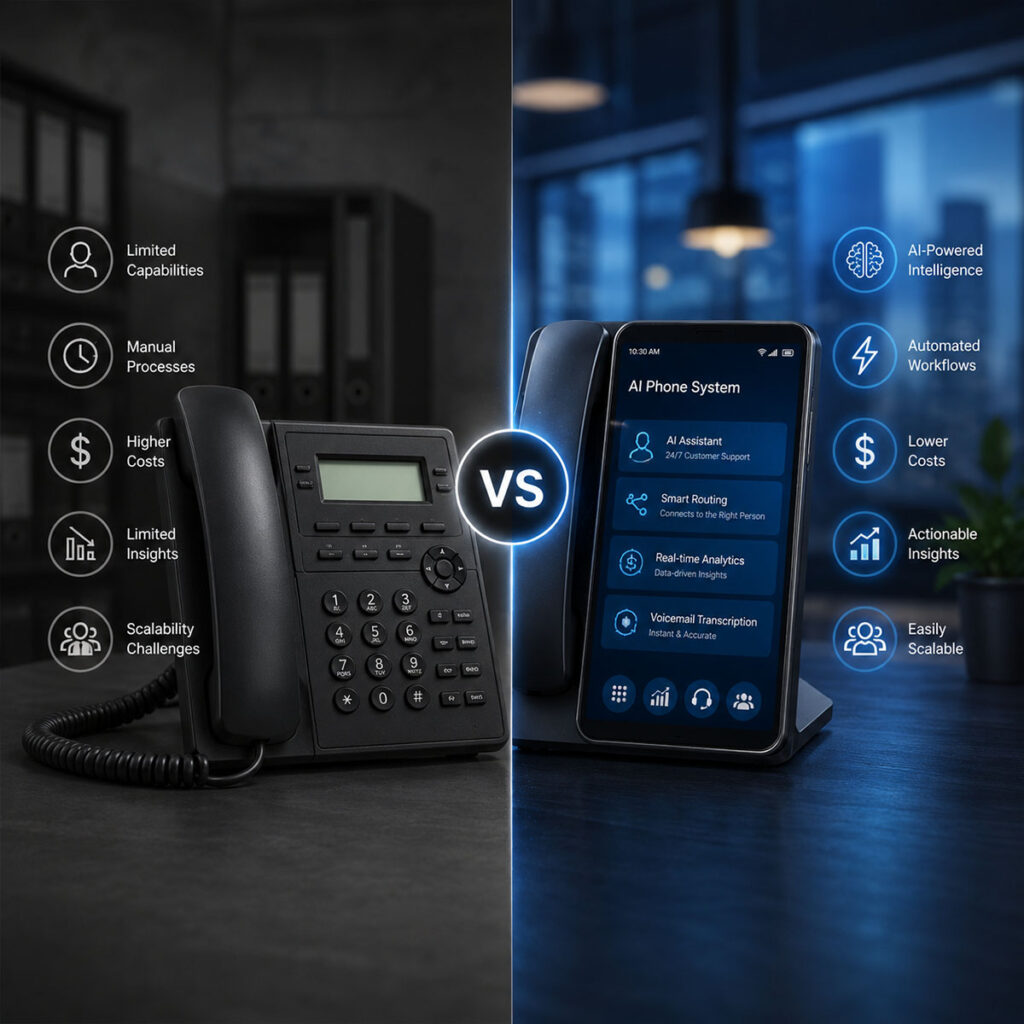
Unanswered Calls
No out-of-hours cover means genuine enquiries go unanswered. AI handles calls at any hour without additional headcount.
Manual Call Routing
Traditional IVR menus frustrate callers. AI routes based on intent, not button presses.
Admin Overhead
Manually logging calls, writing notes, and updating CRMs pulls staff away from higher-value work.
Scalability Costs
Adding lines on traditional PBX is slow and expensive. Cloud-based AI systems scale per user without hardware changes.
PSTN Switch-Off
The UK PSTN network is being retired. Businesses still on analogue lines need to migrate AI-enabled VoIP is the natural replacement. The stop-sell on new PSTN and ISDN lines is already in effect, and existing services continue only until local exchanges switch off.
| Provider | Best Suited For | Key AI Features | Pricing From (UK) | Considerations | UK Support |
|---|---|---|---|---|---|
| The VoIP Shop | Managed UK deployments | Smart routing, virtual receptionist | Custom quote | Pricing non-public | ✓ |
| Dialpad | AI-native productivity | Live transcription, AI coaching, post-call summaries | ~£12/user/mo | Some AI features locked to higher tiers; Pro min. 3 seats | ✓ |
| RingCentral | Unified communications (UCaaS) | AI summaries, analytics, sentiment | ~£20/user/mo | AI transcription on higher tiers; complex plan structure | ✓ |
| Aircall | CRM-driven sales & support | CRM auto-logging, call tagging, AI add-on | ~£30/user/mo | AI is a paid add-on; 3-user minimum; premium pricing | ✓ |
| Teams Phone | Microsoft 365 environments | Copilot recap, transcription, Teams-native | ~£8/user/mo | Requires M365 licence; setup complexity often underestimated | ✓ |
| Zoom Phone | Simplicity & Zoom-first teams | AI voicemail transcription, auto-attendant | ~£10/user/mo | Limited AI depth vs dedicated platforms | ✓ |
| Vonage | API & custom call workflows | CPaaS, custom IVR, AI flow builder | ~£14/user/mo | Requires developer resource for advanced features | ✓ |
| 8x8 | International teams | Multi-region routing, analytics, compliance | ~£20/user/mo | Pricing increases significantly at enterprise scale | ✓ |
Pricing accurate as of May 2026. UK pricing is indicative GBP rates vary by tier, billing cycle, and team size. AI add-ons or managed deployments may require a custom quote. Always request a full written cost breakdown before committing. Aircall publicly shows pricing starting at $30 per licence per month and positions AI separately, which supports the point that add-ons and minimum-seat structures can materially change the real monthly cost.
Compare providers side by side
The VoIP Shop offers strong managed support for UK businesses that want a phone system deployed and maintained by a specialist team, rather than configuring it themselves. Their AI-powered routing and virtual receptionist capabilities suit professional services, multi-site operators, and healthcare practices that need reliable call handling without in-house IT involvement. Their UK-first approach means compliance considerations including GDPR and call recording obligations tend to be factored into deployments rather than left to the customer. Pricing is provided on enquiry and reflects the managed nature of their service. UK businesses evaluating managed deployments should still request written detail on porting, support windows, retention controls, and any add-on costs before signing.
Strengths
Considerations
Best for: Businesses wanting managed UK deployment and hands-on support rather than self-service setup.
Dialpad is built AI-first rather than AI-added. Live transcription, call coaching prompts, and post-call summaries are positioned as core capabilities. Where Dialpad has an edge over broader UCaaS platforms is on AI depth and speed of deployment. Where it falls short is on breadth if you need a wider communications suite, deeper video collaboration, or larger-scale contact centre tooling in one platform.
Strengths
Considerations
Best for: Sales-focused teams prioritising AI coaching, transcription, and fast deployment.
RingCentral is one of the more comprehensive UCaaS platforms available to UK businesses combining calls, video, messaging, and AI analytics in a single environment. Its positioning as an AI cloud phone system with unified communications supports the case for businesses that want one communications platform rather than a standalone voice product. Compared with more AI-native voice-first products, RingCentral trades some simplicity for broader platform coverage. That makes it more suitable for mid-market teams with varied workflows than for very small businesses that only need a straightforward business calling system.
Strengths
Considerations
Best for: Mid-sized businesses wanting voice, messaging, video, and analytics in one platform.
Aircall’s main strength is integration depth with CRM and helpdesk tools. Its public pricing starts at $30 per licence per month, and the vendor positions AI as part of a broader customer communications platform rather than a low-cost entry plan. The trade-off is cost. Businesses should assume the real monthly spend may rise once AI features, international usage, analytics extensions, or support options are added, so a full cost breakdown matters more here than with simpler VoIP platforms.
Strengths
Considerations
Best for: CRM-driven sales and support teams that rely heavily on integrations and workflow automation.
For businesses already running Microsoft 365, Teams Phone reduces friction by keeping calls, meetings, and messaging inside one environment. The practical caveat is that PSTN connectivity still has to be configured through Calling Plans, Operator Connect, or Direct Routing, and businesses often underestimate the deployment work around telephony migration. That matters most for teams moving off analogue or ISDN services as part of PSTN retirement. A Teams-based deployment can be cost-effective, but the real-world reality often includes number porting, telecom coordination, and staged onboarding rather than a same-day switch.
Strengths
Considerations
Best for: Businesses already standardised on Microsoft 365 and Teams.
Zoom Phone is a lower-friction option for businesses already using Zoom for meetings. It is easier to position as a straightforward cloud phone platform than as a feature-heavy intelligent call handling solution, which is why it suits teams prioritising ease of rollout over AI depth.
Strengths
Considerations
Best for: Existing Zoom users wanting a simple cloud phone rollout with minimal complexity.
Vonage is better suited to businesses that want to build bespoke communication flows rather than adopt a pre-packaged phone product. Its CPaaS approach aligns with teams that have developer resource and want custom IVR, routing logic, or embedded communications workflows.
Strengths
Considerations
Best for: Businesses with developer resource needing custom communication workflows or API flexibility.
8×8 is better aligned with businesses managing distributed teams, multiple regions, or international customer coverage. The broader migration context also matters here, because businesses moving off legacy telephony are being advised to audit dependent systems and migrate before supplier lead times tighten in late 2026. The trade-off is that international capability can be unnecessary overhead for domestic-only teams. Businesses focused purely on UK calling often get better value from simpler cloud communications platforms with fewer enterprise layers.
Strengths
Considerations
Best for: International or multi-location businesses needing broader global calling coverage.
Find platforms matching business needs
Compare practical AI features before choosing
| Aspect | AI Phone Systems | Traditional Systems |
|---|---|---|
| Call Routing | Intent-based, automatic | Manual or basic IVR button menus |
| Out-of-Hours | AI virtual answering, 24/7 | Voicemail only |
| Setup | Cloud-based, typically low IT overhead | Hardware-dependent, often requires engineer visits |
| Scalability | Per-user, scales on demand | Slow to add lines; capital expenditure |
| Analytics | Real-time AI reporting and dashboards | Basic call logs |
| CRM Integration | Native on most platforms | Limited or manual |
| Cost Model | Monthly per-user subscription | Capital plus ongoing maintenance |
| PSTN Readiness | Cloud VoIP, unaffected by PSTN retirement | Affected by UK PSTN switch-off |
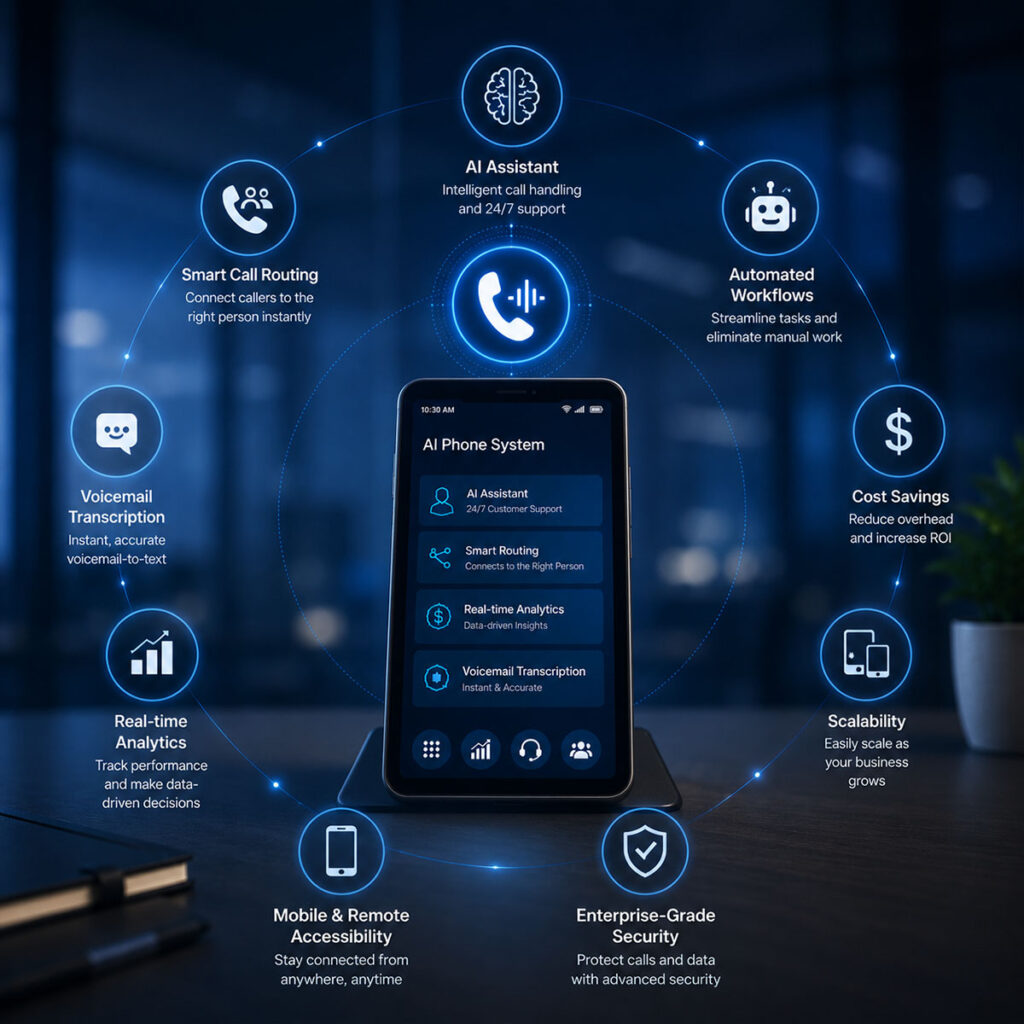
Call recording and AI transcription carry compliance obligations under UK GDPR. Businesses need a lawful basis for processing, a processor agreement where applicable, secure handling, retention controls, and a way to meet access or erasure obligations. Legitimate interests is often used, but the right basis depends on the context. Businesses should also check where call data is stored and what transfer safeguards apply if data leaves the UK. The ICO’s AI guidance and broader GDPR obligations make it clear that AI systems using personal data still have to meet transparency, minimisation, security, and accountability requirements.
Some platforms have minimum user requirements that add unnecessary cost for small teams. Others are designed for enterprise scale and include features a smaller business may never use.
Cloud-based systems are usually easier to provision than legacy PBX, but number porting delays, CRM setup, and staff training still add time. Migration planning guidance for UK businesses recommends auditing dependent systems and not leaving the move until the final months before PSTN retirement.
If your business depends on Microsoft 365 daily, Teams compatibility can remove friction. Third-party integrations exist too, but the quality varies and should be tested in your own environment.
Most platforms offer mobile apps, but call quality and feature parity on mobile can vary. Testing on actual devices and mobile data matters more than relying on office Wi Fi alone.
Advertised pricing rarely reflects the final total once AI add-ons, extra numbers, advanced analytics, or premium support are added. Aircall’s public pricing and broader market pricing examples both reinforce the need for a fully loaded quote.
Phone system downtime is a direct business disruption. Businesses should review uptime terms, support coverage, and what escalation path is included at their chosen plan level.

Independent comparisons not driven by provider relationships
Match providers based on business size, workflow, and support needs
UK-focused guidance covering pricing, PSTN migration, and compliance
Reviewed against real-world deployment and setup factors
Shortlist providers faster without booking multiple sales calls
Pricing, AI add-ons, contract terms, and setup complexity vary significantly between providers. Compare options side by side, request tailored recommendations, and avoid paying for features your business may never use.
An AI phone system is a cloud-based business phone solution that uses artificial intelligence to automate call routing, virtual answering, transcription, and analytics. Unlike a standard VoIP system, the AI layer interprets caller intent and surfaces conversation insights.
They use natural language processing and machine learning to process spoken calls in real time. Performance depends partly on audio quality, accent variation, and background noise, so real-world testing matters before rollout.
Yes. Microsoft Teams Phone integrates natively, while other providers also offer Teams integration, though deployment complexity still depends on PSTN connectivity choices and environment setup.
Yes. Many are priced per user and scale from small deployments upward, but minimum-seat models and AI add-ons can change the economics materially.
Entry pricing in the market often ranges from about £8 to £30 per user per month, with Aircall publicly starting at $30 per licence monthly and some AI-focused systems commonly falling into a similar broad range. Add-ons, managed deployment, billing cycles, and usage charges can push the true monthly cost higher.
VoIP is the underlying technology that routes calls over the internet instead of traditional phone lines. An AI phone system builds on VoIP by adding routing intelligence, transcription, automation, and analytics.
They can be, but compliance depends on how your business configures recording, retention, lawful basis, processor arrangements, and data transfers. UK GDPR obligations still apply in full when transcription and AI features process personal data.
Choosing the right AI phone system depends on how your business handles calls, supports customers, and manages day-to-day communication. Compare providers based on pricing, AI capabilities, deployment complexity, integrations, and support quality rather than relying only on headline features.