


Introduction
Most UK businesses begin searching “What is VoIP” only when phone systems create serious issues. Customers face extended hold times, remote staff miss important calls, and monthly bills rise despite outdated equipment.
Legacy setups impact more than convenience they lead to lost revenue, slower support, and restricted team mobility in flexible work environments. Many organisations therefore adopt Voice over IP, known as VoIP.
This guide details what is VoIP, how VoIP works, and the advantages of a VoIP phone system for your business to support informed decisions before transition.
What is VoIP?
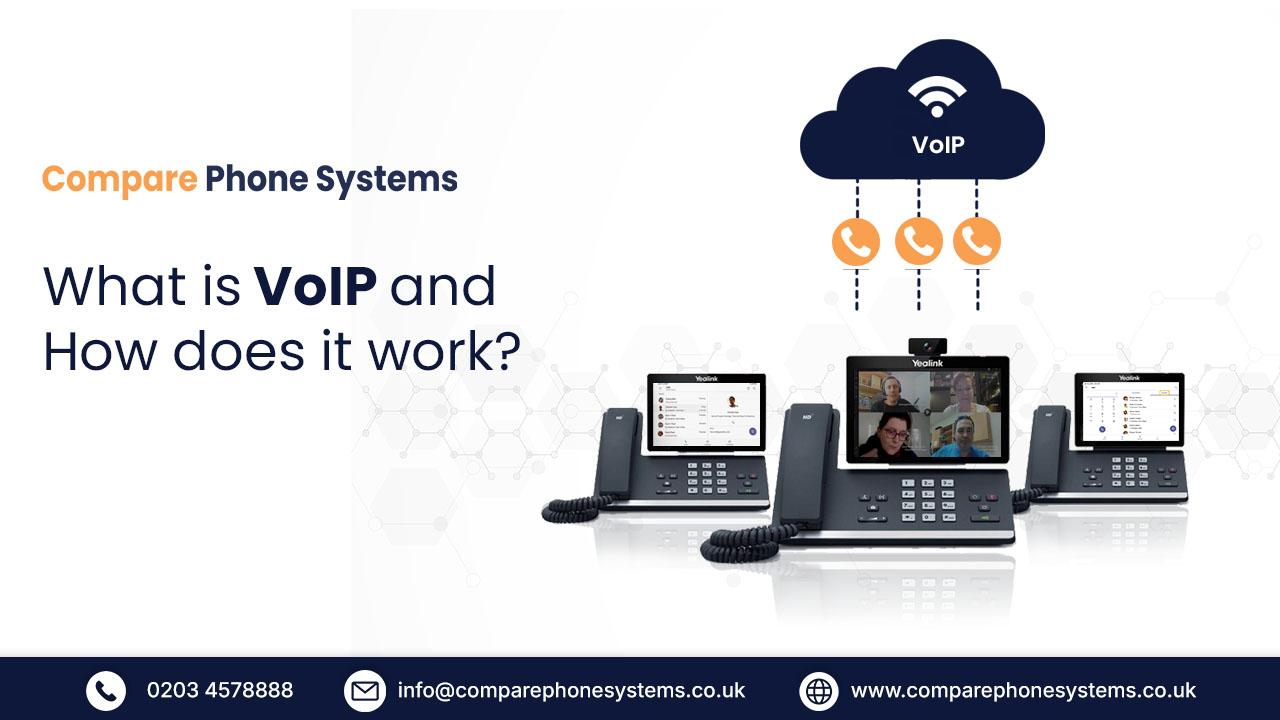
It enables phone calls via internet connections rather than traditional copper lines from carriers. Voice converts to digital packets transmitted over IP networks.
VoIP stands for Voice over Internet Protocol. References to Voice over IP or voice over internet protocol describe this same approach delivering calls through broadband infrastructure.
Businesses gain flexibility as VoIP separates numbers from fixed locations. Teams access calls on desk phones, laptops, or apps using the established company line.
What does VoIP stand for?
It signifies Voice over Internet Protocol, routing voice through internet rather than conventional networks.In practice, calls use the same connection as email, websites, and cloud tools. VoIP thus provides superior scalability and adaptability compared to legacy systems.
How does VoIP work?
Understanding how VoIP works becomes evident through the step-by-step process VoIP calls involve simultaneous signalling for setup and media streams for audio. SIP (Session Initiation Protocol) establishes connections by locating recipients and confirming availability, followed by RTP for real-time packet delivery.
Voice digitises, compresses via codecs, and travels in packets; buffers manage delays or disorder. QoS prioritises voice over other traffic, ensuring clarity during peak usage. The sequence completes in milliseconds, delivering traditional call quality with proper configuration.
What is a VoIP phone system?
A VoIP phone system provides complete business telephony based on Voice over IP technology, extending beyond basic calling. It functions as a cloud PBX with SIP control and codec optimisation, enabling professional communications without on-site hardware.
Key components include business phone numbers, call routing and queues, auto attendants, voicemail and recording, mobile/desktop apps, plus management tools.
Consider it a centralised cloud switchboard managing all inbound business calls.
Types of VoIP systems
Cloud (hosted) VoIP
Provider-managed via online portal; popular for simplicity and no hardware needs.
On-premise VoIP
Runs on company servers for greater control, though maintenance falls to the user.
Hybrid VoIP
Combines cloud and on-site for enterprises with legacy setups.
Hosted options suit most UK businesses for optimal ease, uptime, and value.
Find the best VoIP system for your business in minutes.
VoIP system vs traditional phone lines
Feature | VoIP system | Traditional phone system |
How calls travel | Over the internet | Over phone lines |
Remote working | Built in | Very limited |
Setup | Software-based | Physical wiring |
Scaling | Add users instantly | Requires new lines |
Features | Included | Often paid extras |
VoIP supports dynamic teams; traditional lines suit static offices.
What devices work with VoIP?
Smart Phone
Tablet
Laptop/Desktop (Softphone)
Cordless VoIP Phones
Conference Phones
ATA (for fax ,old phone )
VoIP Gateway
IP-PBX
Headset
Staff maintain access to the business number from any location.
Internet and call quality
VoIP requires stable connections over raw speed focus on low latency, packet loss, and consistent performance.
Issues often stem from unstable Wi-Fi, congestion, absent prioritisation, or low-quality audio gear. Correct configuration yields superior clarity to landlines.
Is VoIP secure?
Modern VoIP equals other platforms in security when properly set up, with encryption, authentication, and access controls.
Intercepted data remains inaudible; monitoring detects anomalies to prevent fraud.
Features of a VoIP phone system
- Auto Attendant: Routes calls automatically, enhancing experience and reducing misses.
- Call Queues: Orders waiting callers for fair handling.
- Call Forwarding: Directs to available devices or users.
- Voicemail to Email: Delivers messages to inboxes for quick response.
- Call Recording: Supports training, compliance, and resolution.
- Mobile/Desktop Apps: Enable calls from anywhere.
- Call Reporting: Tracks volumes for service improvements.
How much does VoIP cost?
In the UK, VoIP typically costs £10–£25 per user per month, depending on the provider, number of users, and features included. Small businesses usually pay closer to £15–£20 per user, while larger teams get lower rates. This price normally covers a UK phone number, unlimited or bundled UK calls, voicemail, call routing, mobile and desktop apps, and an online control panel—without any line rental or expensive hardware.
How to switch to VoIP
Transitions remain straightforward without service gaps numbers persist via porting.
Providers migrate numbers while old systems operate in parallel until full cutover, ensuring seamless handover.
Steps to switch to a VoIP phone system
- Review existing setup and numbers.
- Select provider by features and reliability.
- Initiate number porting.
- Configure users and routing.
- Deploy phones and apps.
- Test flows thoroughly.
- Launch live.
Is VoIP right for your business?
VoIP excels for SMEs, hybrid teams, multi-sites, and high-volume sales/support. Flexible routing and cloud management drive adoption of voice over internet protocol standards.
Not all VoIP systems are built the same. See which one actually fits your business.
FAQ
Can I keep my old number with VoIP?
Yes, you can keep your existing phone number when switching to VoIP. The provider transfers it through a process called number porting. Your customers will not notice any change.
What does VoIP stand for?
Voice over Internet Protocol technology for internet-based voice delivery, enabling cloud flexibility over traditional networks.
What happens to VoIP if power goes out?
VoIP stops working if your internet or power goes down. However, many systems automatically redirect calls to mobile phones. This keeps your business reachable even during outages.
Can VoIP replace traditional landlines?
Yes, with equivalent functionality plus remote access, analytics, routing for most businesses.
Is VoIP better than PBX?
VoIP is more flexible and cheaper than traditional PBX systems. It runs in the cloud and works on any device. PBX systems are tied to physical hardware and are harder to scale.
Is VoIP reliable for business use?
Reliable with stable internet and quality providers, often matching or exceeding landline performance.
Compare VoIP phone systems
Now that you understand what VoIP is and how it works, the real decision is choosing the right system for your business. VoIP providers differ massively in pricing, call quality, features, and contract terms. A proper phone system comparison lets you see those differences side-by-side, so you can pick a VoIP solution that actually fits how your team works not just what’s advertised.
See side by side VoIP systems before you choose.