




Introduction
The ISDN switch off is one of the biggest changes to UK business phone systems in recent years. Many UK organisations still depend on ISDN lines for calls, alarms, EPOS terminals, But BT is pulling the plug for good as part of Phasing Out outdated copper networks.
This hits any business running ISDN2 or ISDN30, no matter your scale or sector. After the switch-off, these lines will stop working completely.
In this guide, we’ll break down exactly what the ISDN switch off involves, the timeline, who feels the pinch most, and the steps your business should take right now to shift to reliable digital alternatives.
What Is the ISDN Switch Off?
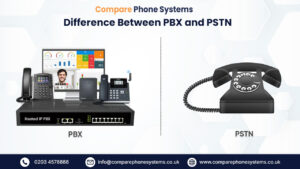
The ISDN switch off is the permanent closure of BT’s Integrated Services Digital Network, which has carried business telephone calls across the UK for more than 30 years. ISDN allowed organisations to run multiple phone lines, PBX systems, and data connections over traditional copper telephone cables.
BT is closing this network because it is expensive to maintain, increasingly unreliable, and not designed to support modern digital communication. Once ISDN is withdrawn, any business still using ISDN circuits will lose external phone connectivity unless it migrates to a replacement service.
The ISDN switch off UK is part of BT’s wider plan to retire all copper phone networks and move the UK to fully digital voice services delivered over broadband and fibre connections.
When Will ISDN Lines Switch Off in the UK?
BT plans to retire all ISDN services by 2027, though the process started years ago. New orders have stopped in most regions While existing contracts disappear upon renewal. Businesses should not rely on ISDN continuing to operate for much longer even if lines still function today.
What this means in practice:
- No new ISDN installations are accepted anywhere across the UK
- Current contracts withdrawn as they naturally expire
- Fault repairs are increasingly limited or unavailable
Waiting until 2027 carries real risk. Many UK organisations face forced migration much sooner when providers simply withdraw services. Proactive VoIP transition (like iPECS hybrid) protects business continuity whilst avoiding last-minute panic.
ISDN Switch-Off Timeline (UK)
| Year | What happens |
|---|---|
| 2018 | BT stopped selling new ISDN lines (WLR stop-sell phases begin) |
| 2020–2022 | Stop-sell expanded and many copper line products were withdrawn |
| 2025 | Recommended migration deadline for most UK businesses |
| 2025–2026 | Most ISDN and PSTN contracts expire and large-scale migrations complete |
| January 31, 2027 | Final PSTN and ISDN shutdown across the UK |
See what your business should switch to
Why BT Is Switching Off ISDN
The BT ISDN switch off is part of a nationwide modernisation of the UK phone network. ISDN and PSTN both run over copper cables that were designed decades ago. These networks are no longer suitable for today’s digital-first businesses.
BT has made the decision to close ISDN because:
- Copper networks are expensive to maintain
- Spare parts for ISDN equipment are no longer widely available
- Digital services provide better call quality and reliability
- Modern networks allow faster innovation and lower operating costs
Rather than investing in outdated infrastructure, BT and other providers are focusing on fibre and IP-based services. This means calls will be carried over internet connections using modern digital technology rather than old-style phone circuits.
For businesses, this change is unavoidable. Whether you stay with BT or move to another carrier, ISDN will not be an option going forward.
How the ISDN Switch Off Affects Your Phone System
If your business uses:
- A PBX connected to ISDN
- ISDN lines for incoming or outgoing calls
- Fax machines or alarms connected to ISDN
- Payment terminals running on ISDN
Then these services will stop working once ISDN is withdrawn.
Your system will not need a small upgrade, it will need a new type of connection to the phone network. Without this change:
- Incoming calls will not connect
- Outgoing calls will fail
- Critical systems such as alarms and card machines may stop working
This makes the ISDN switch off a business continuity issue, not just a technical one.
What Will Replace ISDN and PSTN?
ISDN is replaced by digital calling over the internet using two technologies:
VoIP (Voice over Internet Protocol)
VoIP allows calls to travel over an internet connection instead of physical phone lines.
SIP (Session Initiation Protocol)
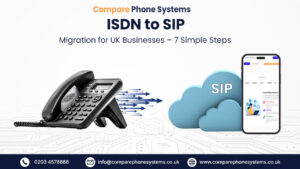
This connects your phone system to the UK phone network, replacing ISDN circuits with digital call channels.
In simple terms:
- ISDN uses physical phone lines
- SIP uses digital channels over broadband
Together, VoIP and SIP provide a modern, flexible replacement for traditional phone services.
Explore VoIP options.
ISDN vs SIP vs VoIP – Comparison
| Feature | ISDN | SIP | VoIP |
|---|---|---|---|
| Uses copper phone lines | Yes | No | No |
| Uses the internet | No | Yes | Yes |
| Scales easily | No | Yes | Yes |
| Monthly cost | High | Lower | Lowest |
| Call quality | Standard | HD digital | HD digital |
| Future-proof | No | Yes | Yes |
ISDN, SIP, and VoIP are all ways to deliver business phone calls but they work in very different ways.
ISDN uses physical copper phone lines provided by BT. Each call requires a dedicated channel, which makes it expensive, inflexible, and limited in capacity. Because it depends on the UK’s copper network, ISDN is now being permanently switched off.
SIP is the digital replacement for ISDN. Instead of physical phone circuits, SIP provides virtual call channels over the internet. It connects your business phone system to the UK public phone network, allowing you to keep your existing phone numbers while moving away from copper lines.
VoIP carries the actual voice calls over the internet. It allows staff to make and receive calls on desk phones, mobiles, or laptops using a cloud-based phone system. VoIP works together with SIP to replace ISDN completely.
Benefits of Moving from ISDN to VoIP
VoIP gives UK businesses more than just a replacement for ISDN it delivers better performance, lower costs, and future-proof reliability.
Key benefits include:
Better call quality – HD voice and digital routing eliminate the noise and drop-outs common on copper lines.
Lower call costs – VoIP and SIP are cheaper than ISDN line rental and reduce mobile and international call charges.
Works anywhere – Staff can take calls on mobiles, laptops, or desk phones from any location.
Scales easily – Add or remove users without installing new physical lines.
Ready for the future – VoIP runs on fibre and broadband, fully compatible with the UK’s digital phone network.
Built-in resilience – Calls can automatically reroute if broadband or power fails.
This is why VoIP is now the standard replacement for ISDN across UK businesses.
What Happens If You Do Nothing?
When your ISDN service is withdrawn, it stops working completely. There is no fallback and no gradual phase-out.
If no migration is in place:
- Customer calls will not reach your business
- Staff will not be able to call out
- Alarm and monitoring systems may fail
- Payment processing can be disrupted
- Business numbers may be lost
BT and other carriers will not maintain ISDN beyond the switch-off dates. Any organisation that delays risks avoidable disruption and revenue loss.
How to Prepare for the ISDN Switch Off
Before switching from ISDN to VoIP or SIP, UK businesses should carry out a few simple checks to avoid delays or service disruption.
Key preparation steps include:
Check your current ISDN contract to see when your lines are due to expire
List every system using ISDN, including phones, alarms, EPOS terminals, and door entry systems
Test your broadband capacity to ensure it can support voice traffic
Confirm number portability so your existing phone numbers can be moved
Choose a VoIP or SIP provider that supports UK compliance and 999 calling
Moving from ISDN to VoIP Using SIP Trunks
Most businesses do not need to replace their entire phone system. Instead, ISDN lines are replaced with SIP trunks.
A SIP trunk links your existing PBX to the phone network via the internet.
The process includes:
Setting up a SIP service
Transferring phone numbers
Reconfiguring the PBX
Routing calls over broadband
From a user perspective, phones continue to work as before, but the underlying network is fully digital.
How Long Does Migration Take?
An ISDN migration usually takes between one and eight weeks.
- Small offices: 1–2 weeks
- Medium businesses: 2–4 weeks
- Multi-site organisations: 4–8 weeks
Timeframes depend on number porting, broadband readiness, and system configuration.
How Much Does It Cost to Replace ISDN?
Replacing ISDN normally involves switching to SIP or cloud-based calling rather than installing new phone systems.
Costs include:
- Digital call channels
- Call charges
- Any PBX upgrades or configuration
In most cases, SIP services are cheaper than ISDN line rental and offer lower call rates, especially for mobiles and international calls. Many businesses reduce their overall telecom costs while gaining more reliable service.
See what your business is likely to pay.
FAQ
1. Do I need new phones for VoIP?
Not necessarily. Some modern desk phones and devices can be configured for VoIP, and many services work on computers or mobile apps. However, very old analogue phones without internet interfaces may need replacement.
2. Is VoIP more reliable than ISDN?
Yes VoIP can offer better call quality and resilience than traditional ISDN lines when paired with quality broadband, automatic failover, and cloud-based features.
3. Is VoIP cheaper than ISDN in the UK?
Yes. VoIP usually costs less than ISDN line rental and offers cheaper call rates, especially for mobiles and international calls.
4. Can I keep my phone numbers?
Absolutely UK geographic numbers port seamlessly from ISDN to SIP/VoIP. Customers dial the same numbers after migration. Your telecom partner handles the transfer during the switch.
5. Is VoIP reliable enough for business use?
Modern business VoIP beats ISDN reliability with proper broadband + SIP trunks. Superior call quality, automatic failover, plus features ISDN never offered. Most UK firms completed migration years ago successfully.
Conclusion
The ISDN switch off is no longer a future event it is already happening across the UK. Businesses that plan ahead can move smoothly to modern digital phone systems without disruption. Businesses that delay may experience service disruption when ISDN is withdrawn, affecting customer calls and critical business communications.
See your ISDN replacement choices