










Introduction
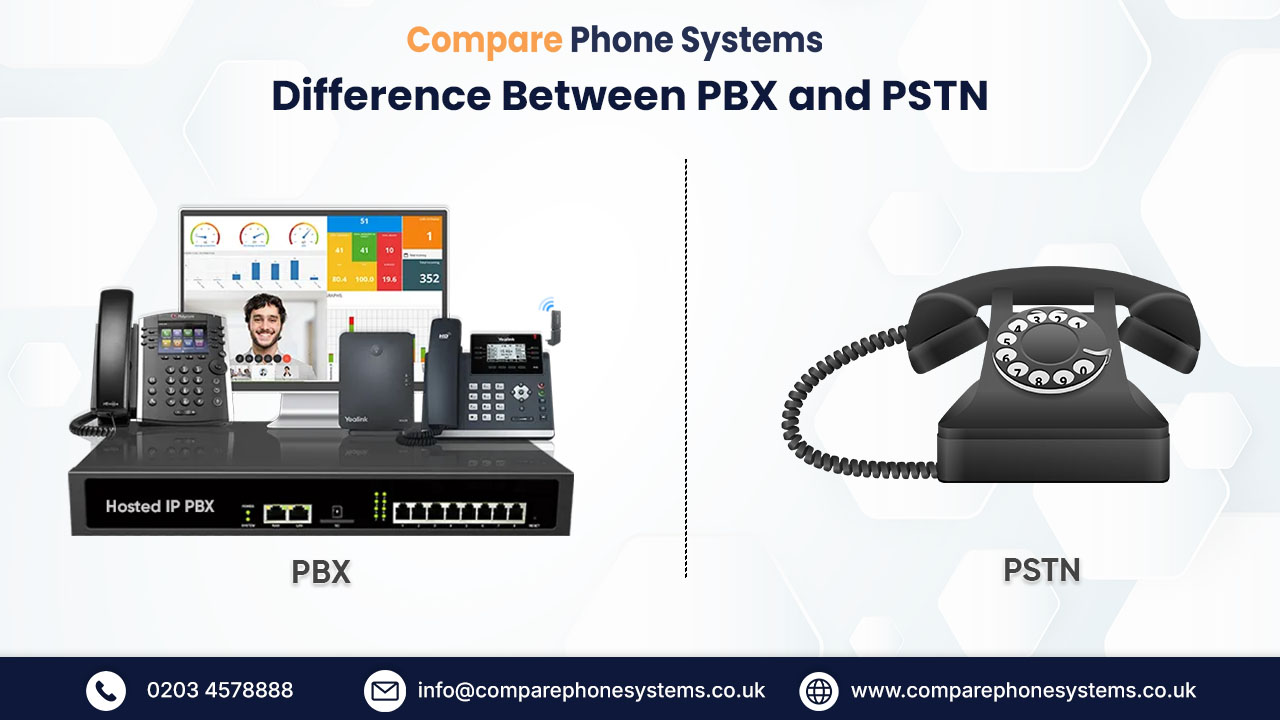
Understanding the difference between PBX and PSTN is essential for businesses that depend on phone systems for daily communication. Although these terms are often mentioned together, they are not alternatives. PSTN provides the public network that carries external calls, while PBX controls how calls are handled inside a business.
This guide explains what PBX and PSTN are, how each works, the key differences between them, how they operate together in real business environments, and how cloud phone systems are changing traditional setups as the UK PSTN switch-off approaches.
What Is PSTN?
PSTN means Public Switched Telephone Network. It forms the traditional public phone system that enables calls between different locations. Telecom firms own and run the PSTN setup, which has long used copper lines and exchanges.
Businesses have relied on PSTN for years to link office phones with customers, suppliers, and the public network.
How PSTN Works
A PSTN call travels through exchanges that set up a dedicated line from caller to recipient. That line stays open throughout the call and is released once the call ends.
PSTN focuses on voice calls above all. While reliable, its feature set remains basic with limited call-handling features.
Benefits of PSTN
- Stable and well-established telephone network
- Does not depend on an internet connection
- Suitable for basic business calling needs
- Works with older and legacy telephone equipment
Limitations of PSTN
- Each simultaneous call requires a separate physical line
- Limited call management and control features
- Scaling becomes costly as the business grows
- Ongoing line rental and maintenance costs
- Traditional PSTN and ISDN services in the UK are being phased out by January 2027
Understand PSTN basics
What Is PBX?
PBX stands for Private Branch Exchange. It serves as a business’s private phone system to handle calls. Staff can make internal calls, share external lines, and manage incoming and outgoing calls in an orderly fashion. Unlike PSTN, the business or its service provider runs the PBX.
How PBX Works
The PBX serves as the central point for business calls. It connects internal extensions, routes incoming calls to the proper person or team, and manages outbound calls.
PBX systems handle both internal and external calls through routing, extensions, and rules, while using outside networks such as PSTN or SIP trunks to carry calls beyond the business.
Calls between staff remain entirely inside the PBX. When external contact arises, the PBX applies its rules before connecting to the external network.
Difference Between PBX and PSTN in Call Handling
PBX manages and controls how calls are handled
PSTN carries calls to and from the outside world
Types of PBX
- On-Premise PBX – Based at the business premises and handled internally. Requires dedicated hardware and ongoing maintenance, providing complete control though with reduced flexibility.
- Hosted PBX – Handled by a provider, reducing on-site requirements and simplifying management.
- Cloud Hosted PBX – Provided over cloud platforms, delivering great flexibility, easy growth, and strong support for remote and hybrid teams.
- Hybrid PBX – Combines on-premise equipment with cloud components, favoured by companies shifting from legacy systems.
Benefits of PBX
- Enables internal calling using extensions
- Allows multiple users to share external phone lines efficiently
- Provides call features such as transfer, routing, and forwarding
- Creates a more professional call handling experience
Limitations of PBX
- On-premise systems require hardware and ongoing maintenance
- Setup and upgrades can involve higher costs
- Requires an external network for outside calls
- Traditional systems are less flexible for remote working
Understand PBX phone systems
Difference Between PBX and PSTN
The main difference between PBX and PSTN comes down to their roles in business communication.
PSTN serves as the public phone network that links calls across locations.
PBX runs as a private system that oversees and directs business calls.
In straightforward terms:
- PSTN links to the outside world
- PBX handles call control and routing
Grasping this split helps businesses weigh PSTN against PBX more clearly.
PSTN vs PBX – Side-by-Side Comparison
| Aspect | PSTN | PBX |
|---|---|---|
| Primary role | External call network | Call control and routing |
| Ownership | Telecom provider | Business or provider |
| Internal calls | Not supported | Fully supported |
| Call features | Very limited | Advanced |
| Scalability | Line-based | Extension-based |
| Best suited for | Basic calling | Structured business communication |
This comparison shows that PSTN vs PBX is not a competition, but a functional relationship.
How PBX and PSTN Work Together
In a traditional business phone system, the PBX connects to the PSTN so calls can move between the business and the outside world.
Inbound → PSTN → PBX → Your team (Customer calls your business)
Internal → PBX → Extensions (Employee-to-employee calls)
Outbound → Your team → PBX → PSTN (Your team calls customers or suppliers)
Inbound calls come in via the PSTN and get directed by the PBX to the right employee or department. Internal calls stay fully within the PBX. For outbound calls, the PBX selects an available trunk and routes the call out through the PSTN.
This arrangement lets businesses run internal communication smoothly while staying linked to outside callers.
Cloud Hosted PBX and PSTN – What Businesses Should Know
How Cloud Hosted PBX Changes Traditional Setups
Cloud hosted PBX systems shift call management from on-site hardware to secure data centres. Businesses access PBX functionality via internet connections, easing user scaling, remote work support, and cutting infrastructure spend.
Is PSTN Still Required with Cloud PBX?
Most cloud hosted PBX setups skip traditional PSTN lines. They generally use SIP trunks for external calls, with the PBX running on cloud platforms.
The UK PSTN and ISDN switch-off by January 2027 drives the shift to modern call methods without halting daily business talk.
Benefits of cloud PBX
Which Is Better for Your Business – PSTN or PBX?
When PSTN Is Enough
PSTN by itself is suitable for very small offices with low call volumes and no demand for extensions or advanced call features.
When a PBX Is the Better Choice
A PBX suits firms with several staff, regular internal chats, and needs for smart call routing. Most expanding businesses gain from PBX tools, no matter the external call method.
FAQ
1. What is the main difference between PBX and PSTN?
The key difference between PBX and PSTN boils down to roles. PSTN runs the public network linking external calls, whereas PBX oversees and directs calls inside a business.
2. Can a business use PBX without PSTN?
Yes. Today’s PBX setups commonly turn to SIP trunks rather than old PSTN lines for outside calls, letting firms keep full PBX features without legacy PSTN dependence.
3. Do PBX and PSTN work together in business phone systems?
Yes. Traditional arrangements see PSTN handling incoming and outgoing calls, with PBX sorting and managing them across the business.
4. Is PSTN still used by UK businesses?
Certain UK firms stick with PSTN for simple calls. That said, legacy PSTN faces phase-out by January 2027, prompting many to consider alternative solutions.
5. Is cloud hosted PBX better than traditional PBX?
Cloud hosted PBX is often preferred by businesses seeking flexibility, straightforward scaling, and remote work support. On-site PBX fits those set on local control, though with less give.
Conclusion:
PSTN forms the public network carrying external calls, while PBX manages how those calls get handled. Rather than choosing one over the other, businesses need to grasp how these elements fit together in phone setups. Modern cloud hosted PBX options shift call delivery methods, though the basic roles of PBX and PSTN hold steady. Spotting the PBX and PSTN difference equips UK firms to make informed, future-ready decisions.